
Development and Implementation of the Lake Peipsi/Chudskoe Basin Management Programme
The overall goal of the project is to promote improvement of social and economic conditions and sustainable use of natural resources in the Lake Peipsi Basin through developing and implementing the Lake Peipsi Basin Management Program (further “Management Program”). Elaboration and implementation of the Management Program includes development of an institutional and legal framework for regional sustainable development, capacity of the national and local authorities, communication and information system across the border and promoting public involvement on the issues of the sustainable development and environmental protection. A special focus will be placed on the reduction and prevention of the nutrient load and eutrophication and conservation of habitats and eco-systems in the Lake Peipsi Basin. The Project’s objectives are as follows:
1. To develop the Lake Peipsi Basin Management Program as a strategy document and an institutional and legal framework for measures on local and regional development and environmental protection in the water basin.
2. To provide the Estonian - Russian transboundary water commission and other decision makers in the region with reliable and adequate data and research results on issues of nutrient load and eutrophication in the Lake Peipsi Basin, biodiversity situation and land use in the lake basin.
3. To strengthen capacity of authorities on different levels of governance: (a) national (the Joint Commission), (b) regional authorities, as well as (c) local agencies and municipalities to develop a joint management of the transboundary waters and co-ordinated monitoring program on Lake Peipsi.
4. To support capacity building of NGOs and stakeholder groups in the region to participate in decision-making and implementation of issues concerning the joint management of transboundary waters in the Lake Peipsi Basin.
5. To promote use of the best environmental practices in agriculture, small businesses, tourism, land use planning on municipal and individual levels through raising public awareness and environmental education on the eutrophication related issues and other transboundary problems of the Lake in local communities around the lake.
Components of the project include the following:
· Assessment of human activities and development of the Lake Peipsi Management Program as a strategic plan, providing an institutional and legal framework for implementation.
· Development of a joint water quality monitoring strategy.
· Strengthening the institutional and regulatory framework for reduction of nutrient load in the Lake Peipsi Basin and capacity building for river basin authority representatives.
· Development of participatory watershed management through providing support to NGOs and local stakeholder groups, promoting public participation and awareness of water eutrophication problems.
· Conduct demonstration projects, disseminate results and plan for follow up activities.
Peipus
| TDA/SAP |
|---|
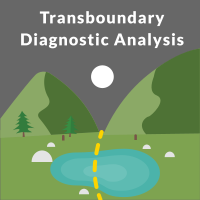
 Transboundary diagnostic analysis of lake Peipsi/Chudskoe
| Documents & Resources |
|---|
 terminal-evaluation
 Lake Peipsi
| General information | |
|---|---|
| GEF ID | 1444 |
| Project type | Medium-Size Project |
| Status | closed (Project Closure) |
| Start Date | 09 Dec 2002 |
| End Date | 31 Dec 2006 |
| GEF characteristic: | |
|---|---|
| Focal Area | International Waters |
| GEF Allocation to project | USD 1,000,000 |
| Total Cost of the project: | USD 4,775,000 |
| Results |
|---|
| YES - See results data (1444) |
| Partners |
|---|
|
Estonia
, Russian Federation
, Regional
United Nations Development Programme (UNDP) |
| Project contacts |
|---|
|
Natalia Alekseeva
Senior Networking Officer
Harry Liiv
Deputy Secretary General on Estonian Ministry of Environment
Vladimir Mamaev
UNDP/GEF Regional Technical Advisor for International Waters for Europe, CIS and Arab States
Elena Armand
Head of UNDP Environment Unit
|