
Capturing Coral Reef and Related Ecosystem Services (CCRES)
Project Objective: In developing countries coastal ecosystems — coral reefs, mangroves and seagrass beds — provide fish to eat and trade, support tourism, protect coastlines from storms and filter water.
Coastal communities rely on these coral ecosystems for their livelihoods, food and wellbeing. Unfortunately, these ecosystems are under threat from pollution, overfishing, destructive fishing, unsustainable coastal development and climate change.
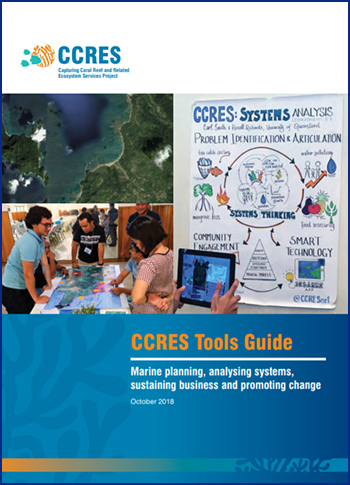 Between 2014-2018 the Capturing Coral Reef & Related Ecosystem Services (CCRES) project, in collaboration with project partners and beneficiaries, developed 16 technical tools and knowledge products to assist managers, policy-makers and planners to improve the management of coastal ecosystems.
The tools can be used for planning Marine Protected Areas (MPAs), modelling socio-ecological systems, developing sustainable enterprises and fostering behaviour change. They were developed following research by multi-disciplinary teams that include scientists, policy-makers, businesses and other experts from a range of fields — collaboration between centres of discovery, learning and engagement in North America, Australia and importantly our partners in Indonesia and the Philippines. The tools can be used individually to address a specific coastal challenge, such identifying the size and location of MPAs, or collectively to deliver a system-wide solution. Download the tools and the complete guide by clicking on the thumbnail or download in parts using this list:
(1) CCRES Tools Guide with corresponding links for downloading every tool
(2) Marine Planning Tools: MPA and Fisheries Simulator I Rebuilding reef fisheries with marine protected areas (MPAs) toolbox I Policy brief: Healthy fisheries through marine reserves I MPA placement optimization tool I MPA size optimization tool I Fish SPACE (Fisheries for Sustaining People’s Access through Conservation and Equitable Systems) I Policy brief: Priority reefs for conservation and fisheries replenishment I Policy brief: Reduced pathogenic bacteria through seagrass protection I Reef React I Coastal Protection 
(3) Systems Analysis: SESAMME I System Simulation Model I SYSTORY
(4) Business Development: Ecosystem-based Business Development (EbBD) Approach for Coastal Communities I Eco-Biz Challenge
(5) Behaviour Change: My Future, My Oceans I FishCollab
The Global Environment Facility (GEF) and The University of Queensland (UQ) funded the CCRES project. The World Bank implemented it and UQ executed it. The CCRES project closed on December 31, 2018. For more information contact the project manager Dr Liz Izquierdo at l.izquierdo@uq.edu.au.
http://ccres.net/
Asia
| TDA/SAP |
|---|
| No items found... |
| Documents & Resources |
|---|
 newsletter
 CCRES e-news #4(Edition 04 | December 2014)
 Republic of the Philippines
 Training workshop at Palawan State University, Puerto Princesa City, on 10-14 November 2014
 CCRES MPA and Fisheries Simulator Tool
 CCRES Fish SPACE (Fisheries for Sustaining People’s Access through Conservation and Equitable Systems) (MAC installer)
 PAD (final)
| General information | |
|---|---|
| GEF ID | 4690 |
| IBRD ID | 123933 |
| Project type | Full-Size Project |
| Status | active (Project Approved) |
| Start Date | 19 Aug 2013 |
| GEF characteristic: | |
|---|---|
| Focal Area | International Waters |
| GEF Allocation to project | 4,500,000 USD |
| Total Cost of the project: | 32,310,000.00 USD |
| Partners |
|---|
|
Indonesia
, Philippines
, Regional
International Bank for Reconstruction and Development (WB) |
| Project contacts |
|---|
|
Christian Severin
Senior Environmental Specialist
Peter Mumby
Chief Project Scientist
Liz Izquierdo
Project manager
Damian Hine
Professor
|